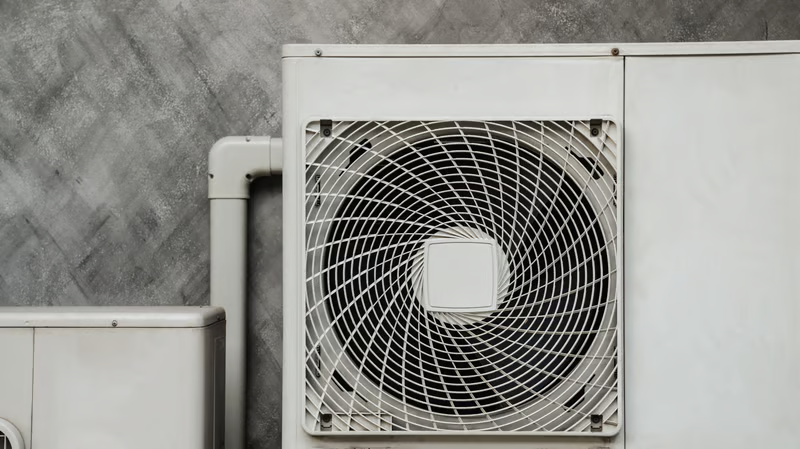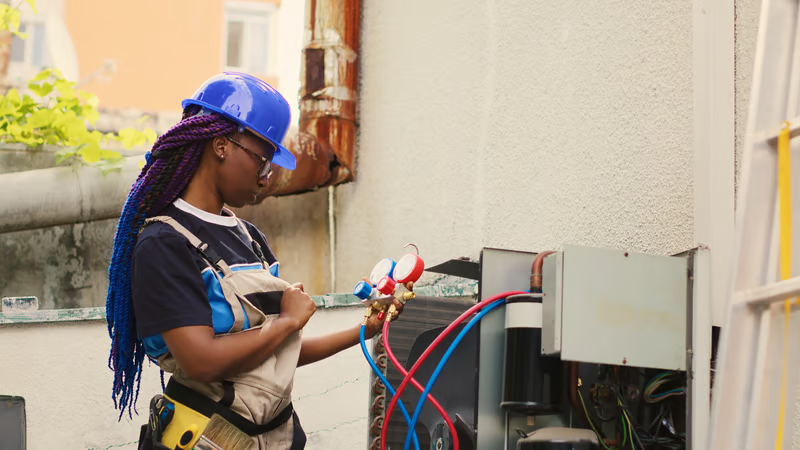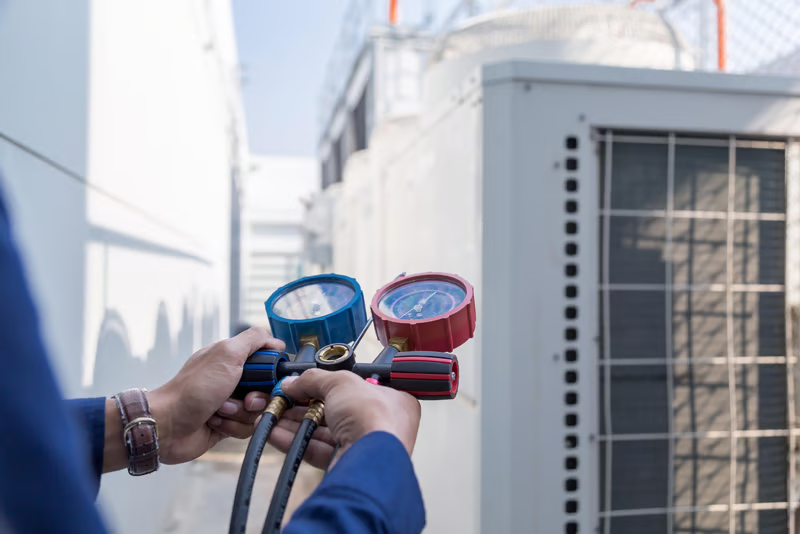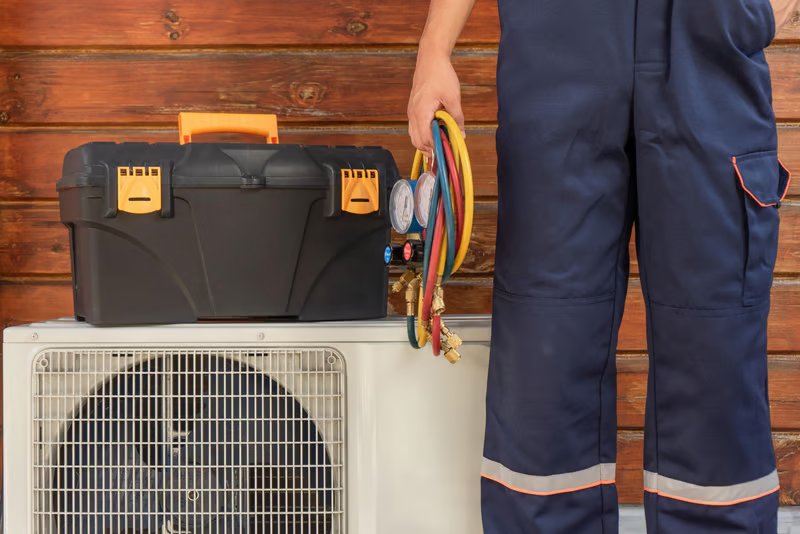
If your Durham home feels cool at the thermostat but still sticky, your air conditioner is cooling without dehumidifying — two different jobs. In the Piedmont’s humid subtropical climate, an AC that runs in short bursts, is oversized, or has a dirty coil, clogged drain, or low refrigerant will drop the temperature without pulling enough moisture out of the air. The fix starts with switching your fan to “Auto,” then checking the filter, coil, and drain — and calling a pro if the humidity stays above roughly 55–60% indoors.
It is one of the most common summer calls we get across Durham and the wider Triangle: the AC “works,” the thermostat reads 72, and the house still feels like a locker room. Floors feel tacky, the bedroom is muggy at night, and no amount of nudging the temperature down seems to help. That is not a temperature failure — it is a humidity failure, and in our climate it is worth understanding before you keep paying to over-cool a house that never feels comfortable.
Cooling and Dehumidifying Are Two Different Jobs
Your air conditioner removes moisture as a side effect of cooling. Warm indoor air passes over the cold evaporator coil, water vapor condenses on that coil, and it drains away — which is why there is a condensate line dripping outside. Cooler air simply holds less moisture.
But that only works when the system runs long enough, and steadily enough, for water to condense and drain. If the AC blasts cold air and shuts off quickly, it lowers the temperature before it ever pulls meaningful moisture out. You end up cold and clammy at the same time — the exact complaint we hear most from Durham homeowners in July.
Why Durham’s Climate Makes This Worse
Durham sits in North Carolina’s Piedmont, where summers are hot and heavy with humidity. The heat index routinely climbs well above the actual temperature, which means the air your AC has to process is loaded with water. A system that would keep a home in a drier climate comfortable can leave a Durham house sticky, because here the moisture load is the harder half of the job.
That is why we tell people summer comfort in the Triangle is a moisture problem first and a temperature problem second. Getting humidity under control often means a more comfortable home at a higher thermostat setting — which lowers your Duke Energy bill instead of raising it.
6 Reasons Your AC Isn’t Pulling Out the Moisture
Persistent indoor humidity with the AC running usually traces back to one of these. Some you can check yourself; others need a technician.
| Cause | Tell-tale sign | Fix |
|---|---|---|
| Fan set to “On” | Air blows even when not cooling; humidity spikes between cycles | Switch thermostat fan to “Auto” |
| Oversized system | Very short cooling bursts; cold but clammy | Load calculation; sizing/setup correction |
| Dirty filter or coil | Weak airflow; higher bills | Replace filter; professional coil cleaning |
| Low refrigerant | Warm or uneven cooling; coil may ice over | Leak diagnosis + recharge (pro only) |
| Leaky ductwork | Muggy rooms; dust; uneven temps | Duct inspection and sealing |
| Clogged condensate drain | Water near indoor unit; musty smell | Clear and treat the drain line |
1. Your fan is set to “On” instead of “Auto”
This is the single easiest fix, and it is behind a surprising number of “humid house” calls. With the fan on “On,” the blower runs constantly — even when the AC is not actively cooling. Between cooling cycles, that moisture sitting on the coil gets blown right back into your rooms before it can drain. Set the fan to Auto so it only runs during a cooling cycle, and see if things improve over a day.
2. The system is oversized and short-cycling
An air conditioner that is too big for the home cools the air so fast that it shuts off before it can dehumidify. It then kicks back on a few minutes later — a pattern called short cycling. In Triangle new builds especially, we see AC units sized bigger than the house needs, which leaves them chronically clammy. A correct load calculation is the real fix; this is one of the most common reasons a “working” AC never feels comfortable here.
3. A dirty filter or evaporator coil
A clogged filter or a grimy coil chokes airflow, so the system can’t move enough air across the coil to condense water efficiently. In our long, humid cooling season, coils foul faster than most homeowners expect. Change the filter on schedule, and have the coil professionally cleaned as part of routine maintenance.
4. Low refrigerant
If the refrigerant charge is low — usually from a slow leak — the coil can’t get cold enough to pull moisture out, and it may even freeze over. This is not a DIY fix: handling refrigerant legally requires EPA certification. A technician needs to find the leak, repair it, and recharge to spec rather than just topping it off.
5. Leaky ductwork
Ducts running through a hot attic or crawlspace can pull humid, unconditioned air into the system through gaps and bad joints. That moisture-laden air gets distributed through the house faster than the AC can remove it. Sealing leaky ducts often makes an immediate difference in how muggy a home feels.
6. A clogged condensate drain
All that condensed water has to go somewhere. If the condensate drain is clogged — common in our humidity, where the line stays wet all summer — water backs up, the system can shut down on a safety switch, and moisture lingers. Clearing and treating the drain line is a standard part of a tune-up.
What Indoor Humidity Should Actually Be
Most comfort professionals aim for indoor relative humidity in the 45–55% range. As a general guideline, keeping it below about 60% helps discourage mold and dust mites; above that, a home starts to feel damp and muggy no matter the temperature. A cheap hygrometer from any hardware store lets you see your real number — if you are reading 60%+ with the AC running, something on the list above is worth investigating.
Quick Fixes You Can Try Today
- Set the thermostat fan to “Auto,” not “On.”
- Replace a dirty air filter (check monthly during the cooling season).
- Make sure supply and return vents aren’t blocked by furniture or rugs.
- Check that the outdoor unit is clear of leaves, grass, and debris.
- Look for water pooling near the indoor unit — a sign of a clogged drain.
- Put a hygrometer in your main living space to track the actual humidity.
If you’ve tried these and the house still feels sticky, the cause is likely one of the pro-only items — sizing, refrigerant, coil, or ducts.
When to Call a Durham HVAC Pro
Short cycling, a coil that keeps icing over, warm air, water around the unit, or humidity stuck above 60% are all signs it’s time for a real diagnosis. Our team has worked on Piedmont systems since 2012, and we’re NATE- and EPA 608-certified, so we test for the actual cause — charge, coil, airflow, ducts, and how the system cycles — rather than guessing. If your AC cools but never dries out your home, professional AC repair in Durham can pinpoint why, and a seasonal AC tune-up keeps the coil and drain doing their job all summer. And if you are weighing the cost of a fix, our Durham AC repair cost guide breaks down what typical repairs run.
Frequently Asked Questions
Why is my AC not getting rid of humidity?
Usually because it’s cooling without running long enough to dehumidify. The most common causes are the fan set to “On” instead of “Auto,” an oversized system that short-cycles, a dirty filter or coil, low refrigerant, leaky ducts, or a clogged condensate drain. In Durham’s humid climate, any of these leaves the house cool but sticky.
Is it normal for humidity to go up when the AC is on?
A brief rise can happen if the fan runs on “On” between cooling cycles, re-circulating moisture off the coil before it drains. But a home that steadily gets more humid while the AC runs is not normal — it points to a real problem like short cycling, low refrigerant, or duct leaks, and is worth having checked.
How long does it take for an AC to remove humidity?
A properly sized system typically brings indoor humidity down over a few hours of normal operation, then holds it there. If yours never seems to catch up — or the number climbs during the muggiest part of a Durham afternoon — the system likely isn’t sized or running correctly for the moisture load.
Is 70% humidity too high for a house?
Yes. Indoor relative humidity around 70% feels damp, promotes mold and dust mites, and makes even a cool house uncomfortable. Most pros aim for 45–55% and try to stay under about 60%. If you’re reading 70% with the AC running, treat it as a signal that the system isn’t dehumidifying properly.
Will mold grow at 55% humidity?
55% is generally within the comfortable, lower-risk range — most mold needs sustained humidity above roughly 60% to take hold. Keeping your home in the 45–55% band is a reasonable target for both comfort and mold prevention in our climate.
How can I lower humidity in my house fast?
Set the fan to “Auto,” replace a dirty filter, and run the AC steadily rather than in short bursts. A portable dehumidifier helps in the short term. For a lasting fix, address the underlying cause — sizing, refrigerant, coil, or ducts — with a professional, since those are what keep humidity high in the first place.
Get Your Durham Home Actually Comfortable
Cool but clammy is a solvable problem — and often a cheaper one to fix than people expect. If your AC isn’t removing humidity, call HVAC Durham NC at (984) 230-5554 for an honest diagnosis and a written estimate before any work begins. We serve Durham and the surrounding Triangle, and we treat comfort the way our climate demands: as a moisture problem, not just a temperature one.