
HVAC in Raleigh, NC
Talk to a person
(984) 230-5554
Raleigh, Wake County
Piedmont, North Carolina
Seven decades of housing
Repairs, replacements, maintenance
Seven decades of housing, one heating season
Raleigh has more housing than every other town on this list combined — 218,200 units — and it spans seven decades of construction. That makes it the one city here where a single rule about the housing stock does not work: a 1960s ranch inside the Beltline, a 1988 subdivision off Glenwood and a 2015 house in the outer ring are all Raleigh addresses, and they fail for different reasons. What they share is a heating season that arrives with a furnace or a heat pump already carrying the last repair. Raleigh HVAC work starts with the equipment, not the postcode.
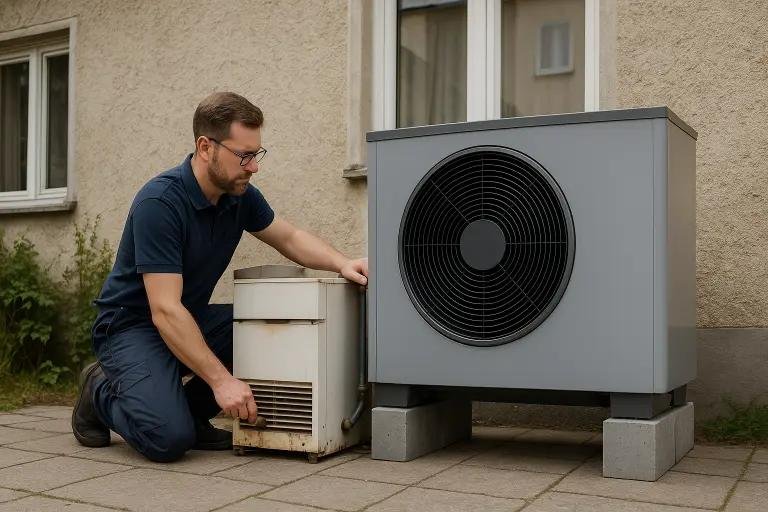
Homes in Raleigh: the local picture
Raleigh’s stock is the widest in this group: a quarter of it predates 1980, a third is from the 1980s and 1990s, and 42.6 percent is from 2000 or later.
310 feet, and what the elevation does not change
The USGS 3D Elevation Program returns 310.3 feet at the point the Census Bureau uses to locate Raleigh, the lowest figure of the towns here and still Piedmont ground. It sits far below the height at which gas equipment is treated differently: Rheem’s high-altitude instructions call for a 4 percent derate per thousand feet only above 2,000 feet, with an orifice change where the gas heating value requires it. Raleigh is roughly 1,700 feet under that line, so a furnace here is installed and adjusted as a sea-level appliance. The elevation tells you the city is on the fall line side of the Piedmont, not in the mountains, and it has no bearing on how a furnace or heat pump performs.
Seven decades in one city
The ACS 2019–2023 five-year estimates put Raleigh’s median year built at 1996: 42.6 percent of the housing went up in 2000 or later, 33.1 percent in the 1980s and 1990s, and 24.3 percent before 1980 — a share that includes 2.9 percent from 1939 or earlier and 6.8 percent from the 1960s. That spread is what separates Raleigh from the smaller towns around it. A 1960s house has usually had three heating systems and one set of ductwork; a 2015 house has had neither touched. The city contains both, often a few miles apart, and the age of the equipment is the only reliable guide to which conversation you are having. Neighbourhood age is a starting point; the model plate is the answer.
How Raleigh heats: electricity, with a large gas minority
Of the 196,924 occupied homes in Raleigh, 115,536 — 58.7 percent — use electricity as their primary heating fuel and 77,066 — 39.1 percent — use utility gas, per the ACS 2019–2023 five-year estimates. Electricity is a fuel category, not a heat pump; the electric share includes heat pumps, air handlers with heat strips and some older resistance systems, and dual-fuel homes count once by primary fuel. The estimates lag the market by roughly two years. In practice, Raleigh is a heat pump city with a very large gas furnace minority, and both kinds of system are common enough that neither can be treated as the exception on a service call, or as the only thing a technician needs to know.
Who serves a Raleigh address
Raleigh sits almost entirely in Wake County: the Census place-by-county geography puts 99.6 percent of the town’s population there and 0.4 percent in Durham County. That small share matters only at the northwest edge, but it is the kind of detail that decides which building department reviews a mechanical permit, and it is easier to check before a replacement is scheduled than after. Utility territory is a separate question and one this page will not guess at: the gas or electric provider, and any rebate eligibility attached to it, depends on the address rather than the city limit. The bill in your hand is the authority, and it is worth reading before a replacement is planned around an incentive.
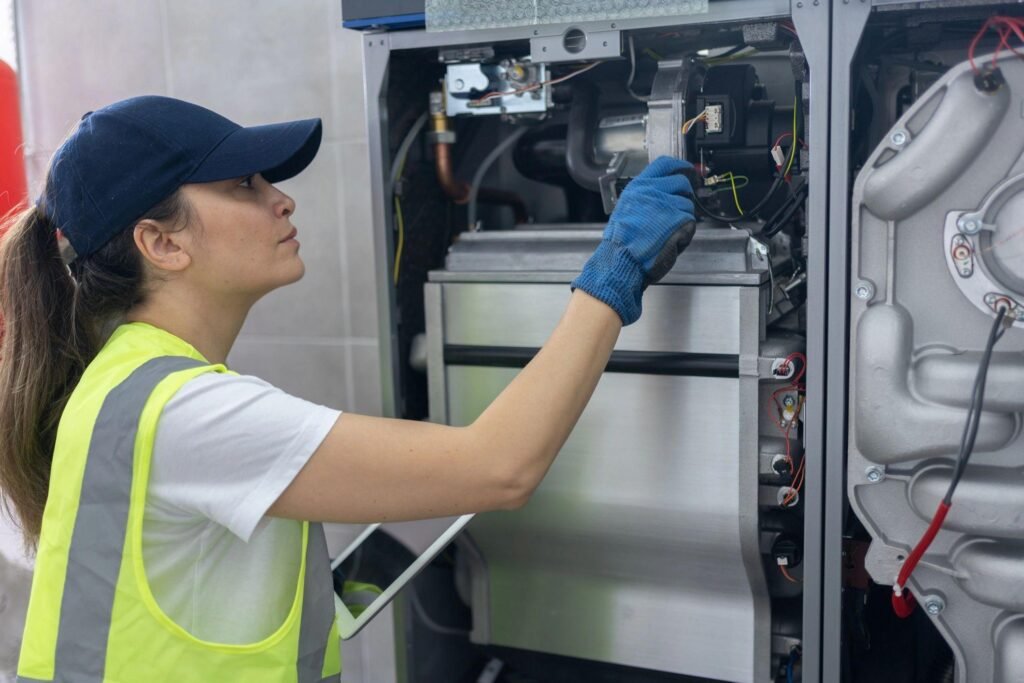
Heating and cooling services in Raleigh
The spread of housing in Raleigh is why the service list is broad rather than specialised. In the pre-1980 stock, the common calls are a gas furnace with a venting or heat-exchanger problem, or a heat pump that has been repaired twice and is being asked to do a third winter. Furnace repair in Durham covers the combustion side, and heating repair in Durham covers heat pumps and air handlers. The difference matters at the unit: a combustion problem and a refrigerant problem can produce the same complaint about a cold house.
In the 1980s and 1990s stock, the equipment is usually on its second system, and the question is whether the replacement was sized for the house as it stands. Heating installation sets out what that has to establish, and AC installation covers the cooling half. In the 2000s and 2010s ring, the original equipment is arriving at the fifteen-to-twenty-year mark, and AC maintenance is the visit that keeps a first system from failing in July. Water heaters are on their own clock, and water heater repair is the call when a tank starts to leak, which in this city is as often a 1990s tank as a new one.
We work across Raleigh and the towns around it, including Cary, Garner, Knightdale, Wake Forest and Morrisville.
Because the city spans so many decades, the first useful question on the phone is not the symptom but the decade the house was built in. A 1960s Raleigh house with a cold room is usually a duct or a venting story; a 2015 house with a cold room is usually a charge, a damper or a thermostat placement. Knowing which one we are walking into changes what we bring and how long the first visit takes, and it is why we ask for the house’s age before we ask for the model number.
Next step
What a service visit covers
The visit is built to find out what the house is actually being asked to do, because in Raleigh the answer changes street by street.
The first hour
- The thermostat is checked against the rooms that stay coldest.
- Filter, return air and static pressure are measured at the air handler.
- On a heat pump, defrost, reversing valve, charge and auxiliary heat are checked in order.
- On a gas furnace, combustion, draft and temperature rise are read at the unit.
- The equipment's model and serial plates are read, because the house's age is not the system's age.
What you leave with
- The readings written down, so the next visit starts from data.
- A clear statement of which component failed and which did not.
- An honest answer on whether the cabinet is worth another repair.
- The repair options ranked by what the measurements support.
- The next step in writing, including what to watch before the cold returns.
Why homeowners in Raleigh work with us
A city with 218,000 housing units rewards a contractor who reads the equipment instead of the neighbourhood. We can tell you what a 1960s Raleigh furnace usually fails on, and why a 2015 heat pump in the outer ring fails differently, without treating either as the default. We measure static pressure and combustion rather than guessing, and we say when a repair is the wrong answer on a unit that has already had two. HVAC Durham NC works across the whole spread of this city, from the oldest streets inside the Beltline to the newest subdivisions at the edge, and the recommendation follows the readings rather than the postcode.
Why this winter, in Raleigh
The timing case in Raleigh is the largest in the group and the least uniform. With 42.6 percent of the housing built in 2000 or later, the city’s newest ring is arriving at the fifteen-to-twenty-year mark now, and those are the calls that feel sudden because the house still looks new. At the same time, 24.3 percent of the stock predates 1980, and those houses are on their third or fourth system — the equipment may be recent, but the ductwork, the flue and the electrical circuit are original.
Both groups meet in the same cold week, and Raleigh’s size makes the queue longer than anywhere else here. A city with 196,924 occupied homes cannot absorb a cold snap the way a town of four thousand can, and the house that has been looked at in October is the one that gets served before the house that fails in January. That is the practical reason the shoulder season matters more in a city than in a small town.
There is one more Raleigh-specific wrinkle. Because the city’s stock spans so many decades, the same block can hold a house with a 1990s heat pump, a house with a 2018 system and a 1960s ranch that has never had its ductwork sealed. A citywide average describes none of them. The visit is what turns three very different houses on one street into three different recommendations.
The upside of that spread is that a failure usually has a neighbour for comparison. When a 1990s heat pump in a Raleigh subdivision fails, the same model is often still running two doors down, and the difference between the two systems is diagnostic in itself. That is a small advantage of an old city over a new one, and it is one we use.
Raleigh, North Carolina
Frequently
Asked
Questions
Does Raleigh's elevation affect a gas furnace?
At 310.3 feet, no. The USGS figure is for the Census place point and sits about 1,700 feet below the 2,000-foot line where Rheem’s high-altitude instructions begin to require a 4 percent derate per thousand feet. A furnace in Raleigh is installed as a sea-level appliance, and altitude is not part of the diagnosis.
When were most Raleigh homes built?
The ACS 2019–2023 five-year estimate puts the median year built at 1996. 42.6 percent of the housing went up in 2000 or later, 33.1 percent in the 1980s and 1990s, and 24.3 percent before 1980, including 2.9 percent from 1939 or earlier. The city spans seven decades of construction.
How do Raleigh homes heat?
Electricity is the primary fuel in 115,536 occupied units, or 58.7 percent, and utility gas in 77,066, or 39.1 percent, per the ACS 2019–2023 five-year estimates. Heat pumps dominate the electric share, gas furnaces are common across the older neighbourhoods, and dual-fuel homes are counted once by primary fuel.
Which county and utility apply to a Raleigh address?
About 99.6 percent of the city’s population is in Wake County and 0.4 percent in Durham County, so almost every address answers to one building department, with a small edge in the second. The utility is address-specific: check the provider named on your bill before relying on any rebate.
How long does an HVAC system last in North Carolina?
A residential heat pump or furnace is usually expected to run 15 to 20 years. With 42.6 percent of Raleigh’s housing built in 2000 or later, a large share of the city’s equipment is entering that window now, while the pre-1980 quarter is already on a later system.
What should I do if the heat stops on a cold night in Raleigh?
If you smell gas, leave the house and call your gas utility before anyone works on the furnace. If the house is safe, turn the thermostat off, check the breaker and the filter, and call (984) 230-5554. Tell us the age of the house and the age of the equipment if you know it, and we will tell you what to check while you wait.