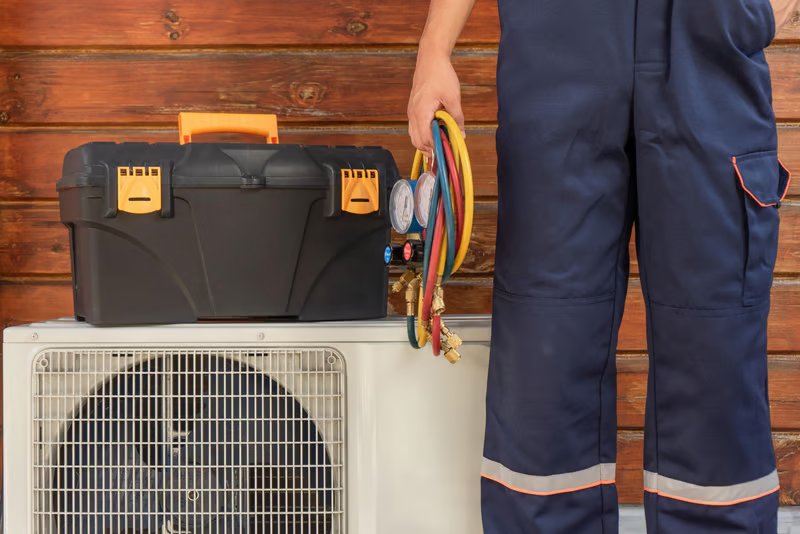
Most residential AC repairs in Durham, NC fall in the range of roughly $150 to $650, with a diagnostic or service call commonly running $80 to $130. Small parts like a capacitor are typically on the low end; major components like a compressor or evaporator coil can run into the thousands. Your actual cost depends on the part, your system’s age and brand, and whether it’s still under warranty — which is why an honest shop gives you a written estimate before any work begins. The figures below are typical Triangle estimates, not flat prices.
If your air conditioner quit on a 95-degree Durham afternoon, the first question is almost always the same: what is this going to cost me? It’s a fair question, and the honest answer is “it depends” — but that doesn’t help you plan. So below is a plain-English breakdown of what AC repair actually costs in Durham and the wider Triangle in 2026, what drives the number up or down, and when a repair bill is really telling you to replace instead.
One note up front: this guide is about residential central AC and heat-pump repair — the system that cools your house. It is not about car A/C (a lot of “AC repair Durham” search results are auto shops). If you need your home comfortable again, you’re in the right place.
What AC Repair Costs in Durham (2026 at a Glance)
Published ranges from local Durham HVAC companies and cost aggregators cluster in a fairly consistent band. Treat these as typical estimates — your written quote may land higher or lower.
| Repair scenario | Typical Durham estimate |
|---|---|
| Diagnostic / service call | $80 – $130 |
| Minor repair (capacitor, contactor, thermostat) | $150 – $400 |
| Mid-range repair (blower motor, refrigerant leak + recharge) | $300 – $700 |
| Major repair (evaporator coil, compressor) | $1,200 – $3,000+ |
For context, several Durham providers publish “most common repairs” landing between about $160 and $600, with complex component failures exceeding $3,000. That spread exists because a $15 capacitor and a $2,000 compressor are both technically “an AC repair.”
AC Repair Cost by Component
Here’s where the money actually goes. These are the parts we replace most often on Durham systems, roughly cheapest to most expensive.
| Repair | Typical estimate | Why it fails |
|---|---|---|
| Capacitor | $150 – $400 | The single most common AC repair; wears out from heat and hard summer runtime |
| Contactor / relay | $150 – $350 | Electrical switch that pits and burns over time |
| Thermostat | $150 – $500 | Failure or miscalibration; smart models cost more |
| Condensate drain clearing | $100 – $300 | Very common in Durham’s humidity — the line clogs and backs up |
| Blower / fan motor | $400 – $900 | Weak airflow, noise, or no air movement |
| Refrigerant leak repair + recharge | $300 – $1,500 | Depends on leak location and refrigerant type |
| Evaporator coil | $1,000 – $2,500 | Corrosion or leaks; labor-intensive to replace |
| Compressor | $1,500 – $3,000+ | The most expensive AC repair; often a replace-or-repair decision |
Why refrigerant repairs vary so much
Refrigerant is one of the widest ranges on the list, and there’s a reason. “Topping off” a system that’s low is cheap in the moment, but it’s throwing money away if there’s a leak — the refrigerant will just escape again. A proper repair finds and seals the leak, then recharges to the manufacturer’s spec. Systems that use older, phased-out refrigerant (like R-22) also cost more to service because that refrigerant is expensive and increasingly scarce. Handling refrigerant legally requires EPA certification, so this is never a DIY line item.
Why Durham’s climate shows up on repair bills
Two of the repairs above — condensate drain clogs and frozen/leaking coils — land on Durham invoices more than they would in a dry climate. Our long, humid Piedmont cooling season keeps the coil wet and the drain line working overtime all summer, so those failures are simply more common here. That’s also why seasonal AC maintenance pays off locally: clearing the drain and cleaning the coil heads off two of the most frequent repair calls before they happen.
What Drives Your AC Repair Price
Two Durham homeowners with the “same” problem can get different quotes. Here’s what moves the number:
- Parts vs. labor. Some repairs are a cheap part with expensive labor (a coil buried in the system), and some are the reverse.
- System age and brand. Parts for older or premium systems can be pricier or harder to source.
- Warranty status. If your system is still under a manufacturer parts warranty, you may only pay labor — a big difference. Warranties often require proof of annual maintenance, though.
- Refrigerant type. Older R-22 systems cost more to recharge than newer R-410A ones.
- Timing. Same-day and after-hours emergency service during a peak-season heat wave can carry a premium with some companies.
Emergency and After-Hours AC Repair Costs
In a Durham summer, an AC failure isn’t always a 9-to-5 problem. When your system dies on a 95-degree Saturday, same-day or after-hours service is worth real money — a dead AC pushes indoor temperatures and humidity to genuinely unsafe levels for kids, older adults, and pets within hours. Some companies attach an after-hours or weekend premium to emergency calls, so it’s fair to ask about that when you book. The trade-off is usually worth it for a true no-cooling emergency, but for a minor issue that isn’t making the house unsafe, scheduling during normal hours can save you the premium. Either way, the repair itself is priced the same once a technician diagnoses it — the premium, when it exists, is for the speed of the visit.
Can You Fix Any of This Yourself?
A few things on your AC are genuinely DIY and can save you a service call. Replacing a dirty air filter, resetting a tripped breaker once, clearing leaves and debris from the outdoor unit, and making sure vents aren’t blocked are all safe for a homeowner. Checking your thermostat batteries and settings costs nothing and fixes more “broken AC” calls than you’d expect.
Everything else on the cost tables above — anything involving refrigerant, electrical components, the compressor, or the coil — is a job for a certified technician. Refrigerant handling legally requires EPA certification, and a mistake with a capacitor or wiring can be dangerous. If the easy checks don’t fix it, that’s your signal to call a pro rather than spend on parts you’re guessing at.
The Diagnostic Fee — and Why “No Hidden Minimums” Matters
Almost every reputable Durham shop charges a diagnostic or service-call fee — commonly $80 to $130 — to send a certified technician out, figure out the actual cause, and quote the repair. Many apply that fee toward the repair if you move forward. What you want to avoid is a company with a surprise repair minimum or vague verbal pricing that balloons on the invoice. We give you the real cause and the real cost in writing before we touch anything, with no hidden minimums — so you can decide with full information.
When the Repair Bill Says “Replace Instead”
Sometimes the smartest money isn’t spent on a repair at all. A common guideline is the $5,000 rule: multiply your system’s age by the repair cost, and if the result tops $5,000, replacing usually makes more sense than repairing. A 12-year-old unit facing a $500 repair lands at $6,000 — leaning toward replacement. It’s a starting point, not a law, but it’s a useful gut check when a big-ticket repair like a compressor or coil is on the table. A system that also uses obsolete R-22 refrigerant or has been failing repeatedly tips the math further toward replacing, since you’d be pouring money into a unit that’s near the end of its life anyway. If you’re weighing it, honest AC installation in Durham starts with a real load calculation and written pricing, not a sales pitch.
How to Keep Your Repair Costs Down
- Change your air filter on schedule — a clogged filter causes several of the pricier failures above.
- Book a spring tune-up so small issues are caught cheap, before peak season.
- Keep the outdoor unit clear of leaves, grass, and debris.
- Don’t ignore early warning signs — warm air, odd noises, or short cycling caught early is a smaller bill than a breakdown in July.
- Keep maintenance records; they can protect a manufacturer warranty that saves you hundreds on parts.
Get Your AC Fixed Right — HVAC Durham NC
You shouldn’t have to guess what an AC repair costs. Our NATE- and EPA 608-certified team has served Durham and the Triangle since 2012, and we diagnose the real problem and hand you a written estimate before any work starts. If your system is down or acting up, get honest AC repair in Durham — call (984) 230-5554 for fast, transparent service.
Frequently Asked Questions
How much is the average AC service call in Durham?
A diagnostic or service call in the Durham area commonly runs about $80 to $130. That covers a certified technician coming out, identifying the actual cause, and quoting the repair. Many companies apply the fee toward the repair if you proceed — worth asking when you book.
What is the $5,000 rule for AC?
Multiply your AC’s age by the estimated repair cost. If the result is over $5,000, replacing usually makes more sense than repairing. For example, a 12-year-old system needing a $500 repair equals $6,000, which points toward replacing. It’s a helpful guideline, not a hard rule — the real decision also weighs efficiency, refrigerant type, and how often the system is failing.
Is it worth fixing a 20-year-old AC unit?
Usually not for a major repair. Most AC systems last about 12 to 15 years, so a 20-year-old unit is well past its prime, less efficient, and may use refrigerant that’s expensive or discontinued. A small, inexpensive repair might buy you a season, but sinking a compressor or coil cost into a unit that old rarely pays off compared with replacing it.
How can you tell if an AC compressor is blown?
Common signs include the outdoor unit humming but not cooling, the breaker tripping on startup, warm air from the vents, or loud clunking and rattling noises. A blown compressor is one of the most expensive repairs, so it’s worth a professional diagnosis before spending — sometimes it’s the compressor, and sometimes it’s a cheaper starting component mimicking one.
What is the 3-minute rule for an AC?
Wait at least three minutes after your AC shuts off before turning it back on. The pause lets internal refrigerant pressure equalize, so the compressor isn’t forced to start against high pressure, which can overheat and damage it. Most newer units have a built-in delay, but a manual restart after a power outage or breaker flip can bypass it.
Straight Answers, Written Estimates
Whether it’s a $200 capacitor or a decision between a big repair and a new system, you’ll get an honest diagnosis and the price in writing from HVAC Durham NC. Call (984) 230-5554 — serving Durham and the surrounding Triangle since 2012.